
Web development for businesses: checklist 2026
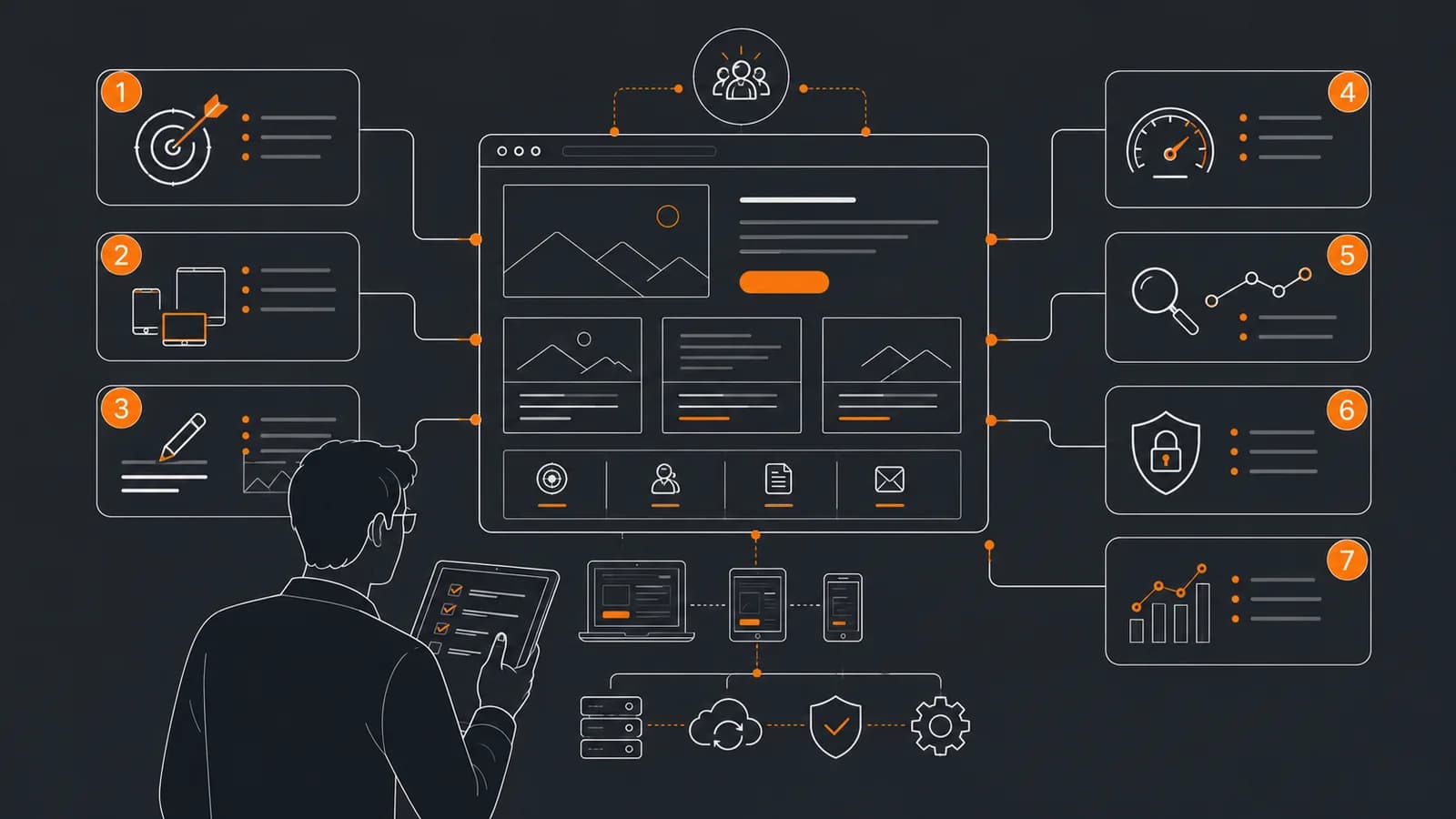
In 2026, web development for businesses must turn a website into a commercial and operational tool, rather than merely displaying an attractive design. A professional website needs measurable objectives, a good mobile experience, performance, accessibility, SEO, data protection, security, analytics and a maintenance plan from the outset.
A professional corporate website must clearly explain what the company offers, whom it works for and what action it expects the visitor to take. If it loads slowly, hides important information or relies on manual processes to handle every enquiry, the project is incomplete even if it looks modern.
The 7 essentials of web development for businesses
Before choosing colours, animations or technology, it is worth checking that the project covers these seven fundamentals:
A specific business objective: generate enquiries, sell, take bookings, provide information, deliver a service or reduce internal work. Every page should contribute to a measurable action.
Architecture and user experience: understandable navigation, a clear hierarchy, search when necessary and journeys that work on mobile phones, tablets and computers.
Useful, manageable content: copy, case studies, services and resources that the team can maintain without relying on the supplier for every minor change.
Real-world performance: fast loading, smooth interaction and visual stability, measured with user data rather than only through a one-off demonstration.
SEO and GEO built into the architecture: URLs, metadata, linking, indexable content and signals that help traditional search engines and generative systems understand the company.
Accessibility, privacy and security: usable forms, appropriate permissions, data minimisation, correctly configured cookies and protection against common errors and attacks.
Measurement and maintenance: analytics, conversions, alerts, backups, updates and clearly defined owners after publication.
Web development for businesses must balance these points. Prioritising aesthetics alone usually pushes problems to the end, when correcting the architecture, content or privacy becomes more expensive.
Performance and Core Web Vitals on a business website
Speed is not merely a technical detail. It affects how easily people can read, navigate, submit a form or complete a purchase. A website may achieve a high score in a test yet perform poorly for real users if it loads too many resources, depends on external scripts or responds slowly on mobile devices.
The Core Web Vitals explained by web.dev measure three aspects of the experience:
Metric What it assesses Threshold considered good LCP When the main content appears 2.5 seconds or less INP Responsiveness to interactions 200 milliseconds or less CLS Visual stability during loading 0.1 or less
These values should be reviewed at the 75th percentile of visits and separately for mobile and desktop. Lighthouse helps during development, but it does not replace field data collected from real users.
In our projects, we see websites that appear simple but load several typefaces, autoplay videos, maps, advertising tags and plugins on every page. An audit often reveals that much of this weight provides no value to the user. Good web development for businesses removes unnecessary dependencies before attempting to conceal them with caching.
SEO and GEO must begin before design
SEO should not be added once the website is already complete. Content structure, URLs, navigation and technology determine which pages can be crawled, indexed and understood. Changing these elements afterwards may require templates to be rebuilt or avoidable redirects to be created.
Google sets three minimum technical requirements: the crawler must not be blocked, the page must respond correctly and it must contain indexable information. For generative features such as AI Overviews and AI Mode, the company states that the fundamentals of SEO remain valid and that there is no special tag that guarantees inclusion.
A well-integrated SEO and GEO strategy includes:
A stable, descriptive URL for each service or topic.
Titles, headings and metadata consistent with search intent.
Visible, useful and easily citable textual content.
Internal links connecting services, case studies, articles and frequently asked questions.
Structured data that matches the visible information.
Authorship, dates, sources and examples that make claims verifiable.
Search Console and analytics configured before launch.
Google’s official guide to AI search emphasises valuable, original and people-focused content. This reinforces a practical conclusion: web development for businesses requires coordination between strategy, content, design and programming, not four isolated tasks.
Security, GDPR and accessibility by design
A business website commonly collects data through forms, analytics, private areas, payments, subscriptions or external tools. Security and privacy must therefore be defined during analysis rather than addressed through legal text copied in at the end.
The Spanish Data Protection Agency explains data protection by default as the application of measures that limit, by design, the amount of data, the scope of processing, the retention period and access. On a website, this means requesting only the necessary information and not activating optional tracking before a valid legal basis is available.
The Agency itself states that accepting and rejecting cookies must be offered at the same time, at the same level and with the same visibility. A banner that highlights “Accept” and hides “Reject” behind several steps should not be considered a good implementation.
The technical checklist should include:
HTTPS and secure server configuration.
Up-to-date dependencies and removal of abandoned components.
Minimum roles and permissions in the content manager and private areas.
Verified backups and a recovery procedure.
Form protection, rate limiting and error logging.
Privacy policy, cookies and notices adapted to the actual processing.
Keyboard navigation, contrast, labels and accessible error messages.
Accessibility does not consist of installing a widget. It must be part of the design, content and code. Our guide to mandatory web accessibility and European regulations explains when specific obligations apply and which barriers should be reviewed.
Corporate website or platform: they are not the same project
An essential decision in web development for businesses is distinguishing a corporate website from a platform. Both run in the browser, but they have different objectives, risks and budgets.
Criterion Corporate website Web platform Main objective Inform, generate leads and rank Run processes or deliver a service Users Visitors and editorial team Authenticated profiles with different permissions Information Services, content, case studies and contact Operational data, documents and transactions Technical complexity CMS, forms and limited integrations Backend, business rules, APIs and advanced security Evolution New pages and campaigns New modules, workflows and profiles
A company may need both layers: a public website for marketing and a private application for customers, suppliers or employees. In that case, they should share identity and data where appropriate, but responsibilities and permissions should be separated.
At Owius, we frequently encounter projects described as “a website with a private area” that, after analysing users, payments, documents and statuses, are actually software products. Identifying this at the outset avoids incomplete budgets and technology decisions that hinder future development.
What website maintenance should include
Publication does not mark the end of the project. Web development for businesses requires an operational phase because browsers, dependencies, campaigns, content and business obligations all change.
Professional maintenance may include:
Monitoring availability, errors and performance.
Updates to the CMS, framework, server and dependencies.
Backups and regular restoration tests.
Reviewing forms, emails and conversions.
Fixing vulnerabilities and incidents.
Editorial support and small iterative improvements.
Analytics, SEO and Core Web Vitals reports.
Response-time agreements according to criticality.
The warranty corrects defects within the delivered scope; maintenance preserves and evolves the solution in response to subsequent changes. The contract should distinguish between the two concepts and clarify which licences, hosting and external services are paid for separately.
The initial budget should be assessed together with the operating cost over several years. Our guide on how much a professional website costs explains the differences between a corporate website, an e-commerce site and a custom platform.
Quick checklist for auditing your current website
You can identify many shortcomings in web development for businesses by answering these questions:
Does the home page explain what the company offers within a few seconds?
Is there one clear primary action on every important page?
Do the forms work and reach the right person?
Does the mobile experience allow every task to be completed?
Are the Core Web Vitals good when measured with real-world data?
Do the services have indexable pages and original content?
Does the cookie banner make rejection equally easy?
Can the navigation and forms be used with a keyboard?
Does the team control the domain, hosting, analytics and access credentials?
Is there a maintenance plan with defined owners and response times?
If several answers are negative, this does not necessarily mean that you need to rebuild the entire website. An audit can separate targeted improvements from structural problems and prioritise them according to impact, effort and risk.
Frequently asked questions
What should a professional corporate website include?
It should include a clear value proposition, an understandable architecture, responsive design, manageable content, measurable forms, technical SEO, performance, accessibility, privacy, security and maintenance. The exact combination depends on the business, but a professional website should generate or facilitate results rather than merely present static information.
Which technology is best for a company website?
There is no universal technology. A CMS may be suitable for an editorial website, while a platform with proprietary processes may need a custom frontend, backend and APIs. The decision should consider features, the team, integrations, security, performance and maintenance cost, not the supplier’s preferences.
How long does web development for a company take?
A corporate website usually requires several weeks or a few months; a platform may take several months and be delivered in phases. Timelines depend on the content, integrations, number of templates and speed of validation. Time should be reserved for testing, migration, redirects and training.
When should a business website be renewed?
It is worth considering when the website no longer represents the business, performs poorly on mobile devices, generates few enquiries, has security problems or makes publishing and development difficult. Age alone is not enough to decide: an audit of objectives, data, technology and maintenance can determine whether improving or rebuilding it is worthwhile.
Can SEO be added after the website has been developed?
Elements can be corrected afterwards, but doing so is usually more expensive and risky. Architecture, URLs, rendering and the content hierarchy are decided during development. Integrating SEO and GEO from the outset prevents duplicate pages, non-indexable content and unnecessary migrations.
In 2026, web development for businesses requires a combination of strategy, design, content, engineering and operations. A website that meets this checklist can generate opportunities, deliver services and evolve; one that ignores these fundamentals quickly becomes a technical and commercial liability.
Owius is a software, app and artificial intelligence development company in Barcelona with more than 25 years of experience. If you need to audit, renew or create a website that is ready to grow, discover our professional web design and development service in Barcelona.