
Mobile application development: 2026 guide
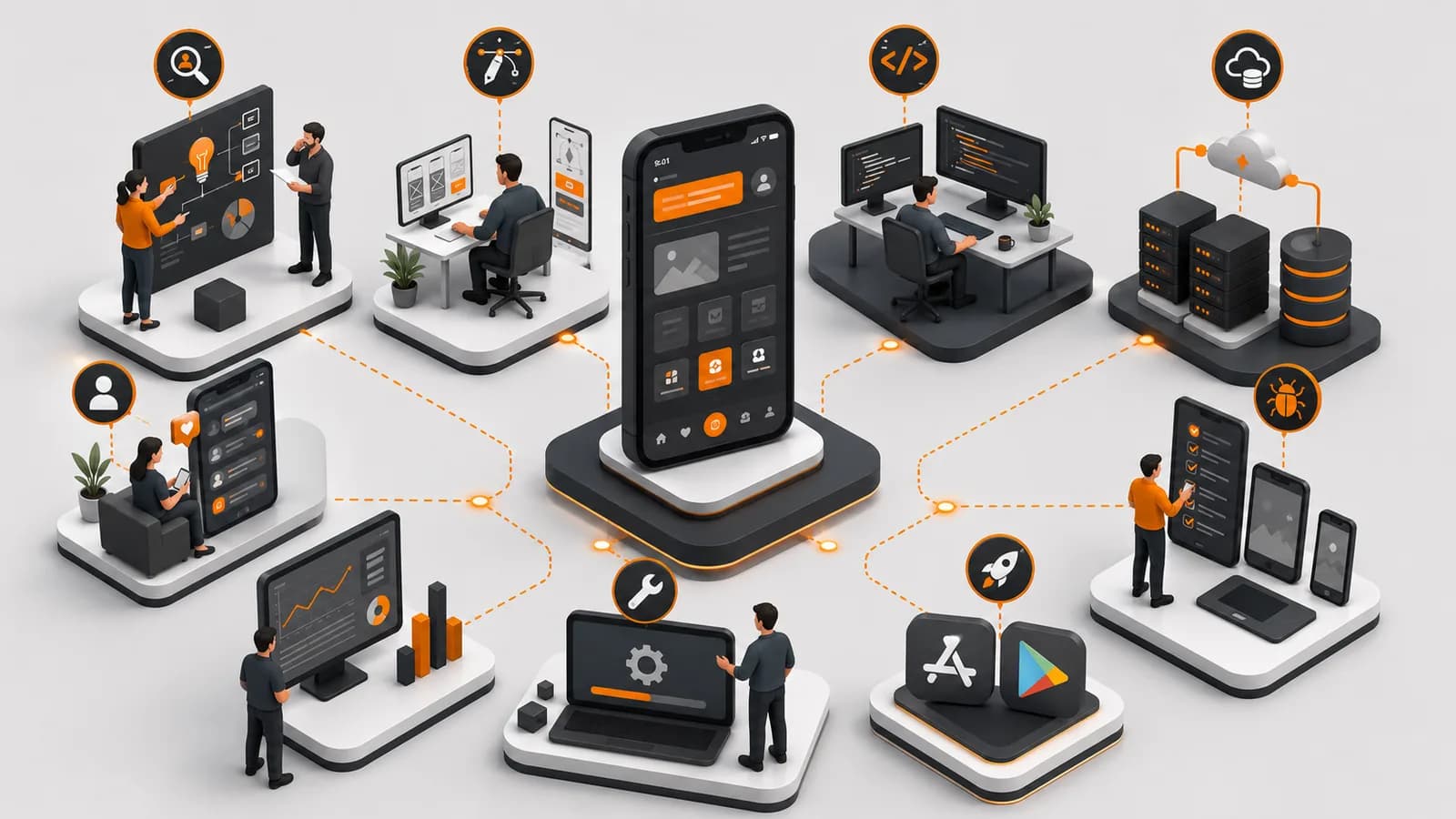
Mobile app development is the process of turning a business need into a digital product that works on phones, tablets and, in some cases, other devices. In 2026, creating a professional app involves analysing the problem, choosing the right technology, designing the experience, developing the frontend and backend, testing, publishing and maintaining it throughout its useful life.
A simple app may be ready in a few weeks, while a product with multiple user profiles, payments, geolocation, offline work or business integrations may take several months. The most important decision is not which framework to use, but which problem the application must solve and what constitutes a reasonable first version for validating it.
Contents of this guide:
Types of mobile app development and which one is right for you
Not all applications are built in the same way. The choice between native, cross-platform or web development depends on performance, device features, budget and the experience users need.
Application type Main advantages Limitations When to choose it Native app Maximum performance, full access to the device and an experience tailored to each system Two separate developments if published for iOS and Android Demanding products, specific hardware, multimedia, healthcare, games or critical processes Cross-platform app A shared codebase, shorter timeline and centralised maintenance May require native modules and platform-specific adjustments Business apps, commerce, services, bookings, communities and MVPs PWA or progressive web app Browser access, immediate deployment and no mandatory installation More limited device access and less presence in app stores Portals, catalogues, internal applications and services with web-based features
Native applications
A native application is developed specifically for an operating system. Swift and Apple’s tools are commonly used for iOS; Kotlin and Google’s official ecosystem are used for Android.
It is the most robust option when the app needs very high performance, complex animations, intensive processing, sensor connectivity or deep adaptation to each platform. The trade-off is that maintaining two codebases increases cost and coordination.
Cross-platform applications
Cross-platform technologies make it possible to share much of the code between iOS and Android. React Native and Flutter are two of the most widely used alternatives for business mobile app development.
This does not mean that the same application automatically works everywhere. Permissions, notifications, payments, the camera and certain components must be tested separately. Even so, a well-designed architecture can significantly reduce duplication.
PWAs and web apps
A PWA, short for progressive web app, is a website designed to behave like an application: it can be installed on the home screen, use certain device features and provide a mobile-friendly experience.
It may be sufficient when a strong app-store presence or advanced access to hardware is not needed. Before investing in two apps, it is worth checking whether a responsive web app can achieve the objective with less complexity.
Our comparison of native, hybrid and PWA apps explores the differences in performance, cost and maintenance in greater depth.
The complete app development process
Professional mobile app development does not begin by programming screens. It begins by reducing uncertainty: who will use the app, which tasks they must complete, which systems it will communicate with and how the outcome will be measured.
1. Discovery and definition
The discovery phase turns a general idea into a verifiable scope. Users, objectives, processes, competitors, constraints, data, integrations and risks are analysed.
The result should include a functional proposal, priorities and an initial estimate. It also determines what will not be part of the first version.
2. Defining the MVP
An MVP, short for minimum viable product, is the smallest version that makes it possible to test a real hypothesis with users. It is not a low-quality app or an unfinished demonstration.
It must include the complete main workflow. If the product is intended to manage bookings, the MVP needs to create, confirm and retrieve a booking, even if loyalty features, recommendations or social functions are left for later phases.
3. UX/UI design
UX means user experience and defines how a task is completed. UI refers to the visual interface: components, colours, typography and states.
Flows and wireframes—schematic representations of the screens—are created first. Clickable prototypes are then prepared to test the logic before programming begins.
In our projects, we find that validating a prototype with the operational team reveals problems that do not appear in a feature list. A button may be well designed and still force the user to repeat information that the company already knows.
4. Architecture and development
The architecture defines how the app, backend, database, integrations and infrastructure are organised. The backend is the part that manages users, rules, data and communication with other systems.
Development is usually organised into short iterations. Each cycle delivers features that can be reviewed, avoiding the need to wait until the end to discover that the product does not match real operating processes.
5. Testing and quality assurance
QA, short for quality assurance, includes functional, visual, integration, performance, security and compatibility testing. It should not be limited to checking that the app opens.
Slow connections, denied permissions, expired sessions, incomplete data, interruptions, screen sizes and different operating-system versions must all be tested.
In applications for field teams, for example, the decisive requirement is often what happens when coverage disappears. Recording work reports, photographs or signatures requires a local queue and synchronisation capable of resolving errors without duplicating operations.
6. Beta and launch
Before publication, a beta version is distributed to internal or external users. This phase makes it possible to collect issues and test the complete process with representative data and devices.
The launch includes app-store listings, screenshots, policies, age ratings, test accounts and documentation for reviewers.
7. Measurement and evolution
After publication, activation, usage, retention, errors and conversions must be measured. The metrics depend on the product: an internal app may measure completed work reports; a store, purchases; and a service app, bookings or requests.
What team is needed to create an app?
Team size depends on scope, but mobile app development needs to cover several responsibilities. In small projects, one person may perform more than one role; in complex products, it is advisable to separate specialisms.
Product owner or product manager: represents the business objectives and prioritises decisions.
Consultant or functional analyst: documents processes, requirements, exceptions and integrations.
UX/UI designer: creates flows, prototypes and the visual system.
Mobile developer: implements the application for iOS, Android or a cross-platform technology.
Backend developer: programmes APIs, data, authentication and business rules.
QA specialist: designs tests, reproduces errors and validates deliveries.
DevOps or infrastructure specialist: automates deployments, environments, monitoring and security.
Project manager: coordinates the schedule, budget, risks and communication.
An API is an interface that allows two systems to exchange information. When the app must connect to an ERP, CRM, payment gateway or logistics provider, the quality of their APIs directly affects the effort required.
In an application connected to an ERP, we have seen that the mobile interface represented only one part of the project. Normalising customers, permissions, statuses and synchronisation errors required more analysis than several visible screens. This work does not stand out in a demonstration, but it determines the product’s stability.
Technologies for creating an app in 2026
There is no ideal stack for every project. Technology should be selected after defining features, devices, volume, integrations and maintenance capacity.
Layer Common alternatives Responsibility Native iOS Swift, SwiftUI Interface and integration with the Apple ecosystem Native Android Kotlin, Jetpack Compose Interface and integration with Android devices Cross-platform React Native, Flutter Share logic and components between platforms Backend Node.js, Java, .NET, Python, PHP Users, data, rules, APIs and processes Data PostgreSQL, MySQL, MongoDB, managed services Persistence, queries and synchronisation Infrastructure Cloud, containers, managed services Deployment, scaling, backups and monitoring
The architecture must allow testing and updates without compromising real data. Development, test and production environments are therefore kept separate.
CI/CD processes—continuous integration and continuous delivery—are also used to automate builds, tests and deployments. This automation reduces manual errors and makes it easier to publish frequent updates.
Artificial intelligence can be incorporated for search, classification, recommendations or assistants, but it should not be added without a use case. A conventional rule may be cheaper and more predictable than a generative model.
The official Android app quality guidelines point out that an application must adapt to different screen sizes, foldable devices and window modes. In 2026, designing solely for a medium-sized phone in portrait orientation is no longer reasonable.
Mobile app development costs and timelines
The price depends on the user profiles, number of screens, backend, integrations, security and technology. These ranges are indicative for professional projects in Spain in 2026:
Project type Typical scope Indicative price Approximate timeline Functional prototype Clickable design or limited technical validation €2,000–€6,000 3–6 weeks MVP Main workflow, few user profiles and simple backend €6,000–€12,000 6–12 weeks Complete professional app Custom design, users, notifications and integrations €15,000–€40,000 3–6 months App with complex backend Multiple roles, payments, dashboard, data and critical integrations From €40,000 6–12 months
These are not fixed rates. Two applications with the same number of screens can have very different costs if one displays content and the other synchronises sensitive data with several systems.
You will find a more detailed breakdown in our guide to how much an app costs in 2026. To prepare your request, you can also use the guide to requesting a mobile app quotation.
The schedule depends on both development and validation. Changing priorities, delaying content or lacking access to external systems can block the team. Our comparison of realistic timelines for developing an app explains what speeds a project up and what delays it.
How to publish on the App Store and Google Play
Publishing does not merely consist of uploading a file. Apple and Google review identity, functionality, privacy, content and compliance with their policies.
Publishing on the App Store
Apple Developer Program membership costs $99 per year, with local prices that may vary. For organisations, Apple verifies the entity and may request a D-U-N-S number.
From 28 April 2026, applications submitted to App Store Connect must be built with Xcode 26 or later and use the SDKs corresponding to iOS 26 and the other current platforms.
Before submitting, it is advisable to review the official App Store Review Guidelines. Among other requirements, Apple requires an accessible privacy policy and complete information so that the review team can use protected features.
TestFlight makes it possible to distribute beta versions before launch, collect feedback and test multiple builds. Approval of a beta does not mean that the final version will automatically be accepted.
Publishing on Google Play
Google Play charges a one-off registration fee of $25. Accounts must verify their identity, and personal accounts may have additional testing requirements before public distribution.
From 31 August 2026, new applications and updates for phones and tablets must target Android 16, API level 36, or a later version. Google updates this requirement periodically to incorporate security and behavioural improvements.
The Data safety form must declare what information the application collects or shares, including data transmitted by third-party SDKs. These declarations must match the app’s actual behaviour.
Store accounts should belong to the client company, not the agency. The supplier can be granted access as a team member, but the organisation must retain control of its public identity, contracts, statistics and future updates.
Maintenance and evolution after launch
Mobile app development does not end with publication. Apple and Google update operating systems, SDKs, policies and requirements; providers change their APIs; and users discover new use cases.
Maintenance can be divided into four levels:
Corrective: resolve errors and incidents detected in production.
Preventive: update dependencies, SDKs and configurations before they cause problems.
Adaptive: respond to new operating systems, devices, policies or external APIs.
Evolutionary: add features, improve journeys and expand the product.
A professional service includes error monitoring, backups, performance reviews, updates, store management and agreed response times.
As a reference, many companies set aside between 15% and 25% of the initial investment each year for maintenance and evolution. This is not a universal rule: an informational app requires less work than a platform that processes payments or supports a critical operation.
Warranty and maintenance should be kept separate. The warranty covers defects within the delivered scope for an agreed period; maintenance addresses subsequent changes in systems, providers and business needs.
Frequently asked questions
What do I need before I start creating an app?
You need to define the problem, users, main workflow and expected outcome. It is also advisable to identify the data, integrations, constraints and budget. You do not need to have every screen decided: a good discovery phase turns the idea into a scope, priorities and a viable first version.
Is it better to develop for iOS or Android first?
It depends on the target audience, the devices used and the required features. A B2B app may begin with the system already used by the team, while a consumer product should analyse the market and user behaviour. With cross-platform technology, both versions can progress in a coordinated way.
How much does mobile app development cost?
A professional MVP typically costs between €6,000 and €12,000, a complete application between €15,000 and €40,000, and a system with a complex backend from €40,000. These are indicative ranges: design, integrations, security, data and testing determine the final budget.
How long does it take to develop an application?
A tightly scoped MVP may require between six and twelve weeks. A complete app typically takes three to six months, while a complex product may exceed six months. Timelines also depend on the client’s availability to validate designs, content, integrations and deliveries.
Who should own the code and accounts?
The client company should control the custom code, repositories, infrastructure and Apple and Google accounts, while respecting the licences of third-party components. The contract must define ownership, access and documentation. This structure reduces dependency and makes it possible for another team to continue maintenance if necessary.
Mobile app development requires a combination of strategy, user experience, technology, testing and continuous operations. The best application is not the one with the most features, but the one that solves a relevant problem with a proportionate architecture and can evolve without being rebuilt every year.
Owius is a software, app and artificial intelligence development company in Barcelona with more than 25 years of experience. If you want to validate an idea, create an MVP or develop a complete product, discover our mobile app development service in Barcelona.