
Artificial intelligence for SMEs: 7 cases in 2026
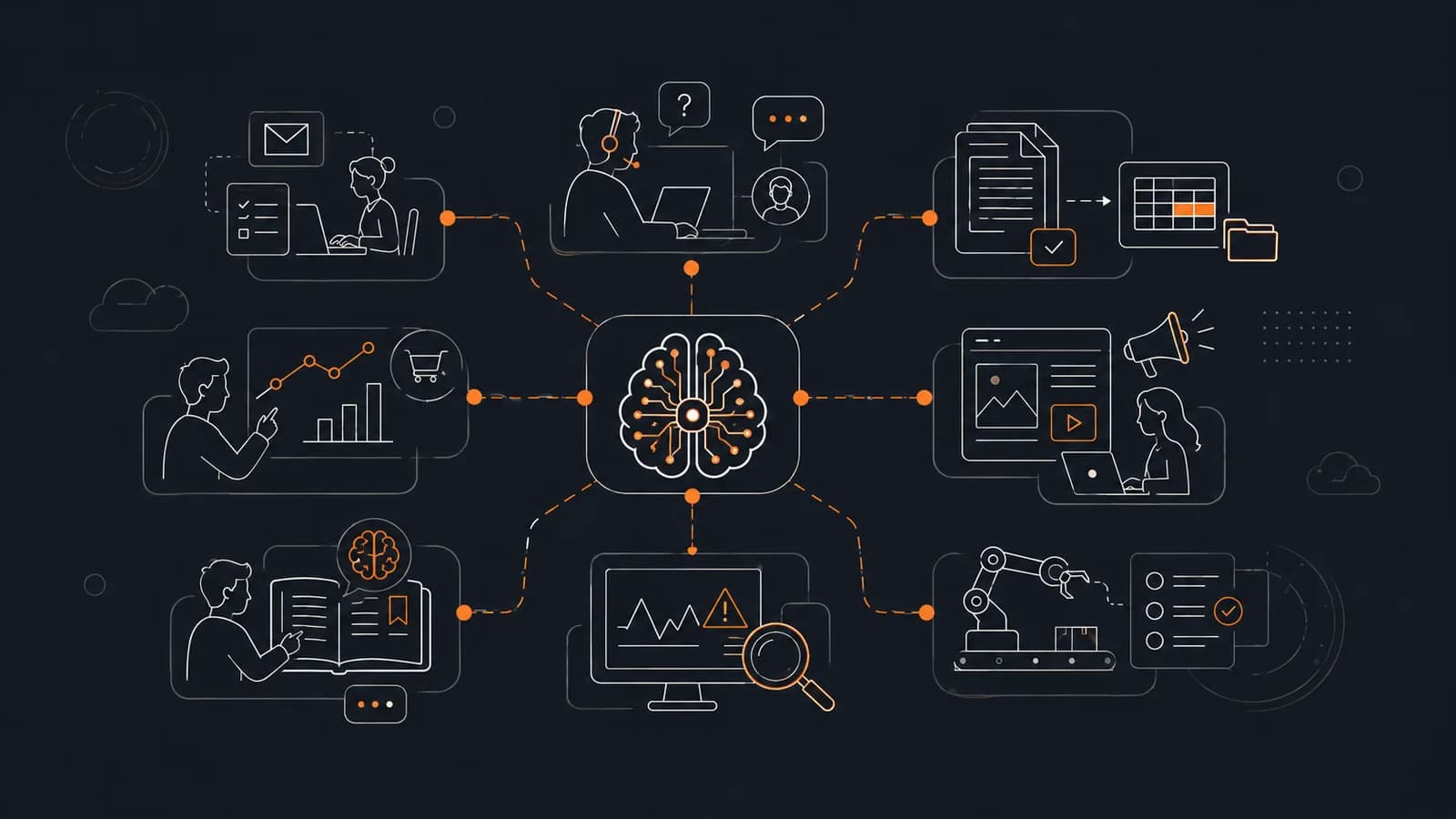
Artificial intelligence for SMEs can already automate administrative tasks, answer enquiries, extract data from documents and forecast sales without requiring companies to build a technology laboratory. In 2026, the most cost-effective approach is to choose a repetitive and measurable process, test a limited solution and retain human oversight before expanding it.
Adoption is accelerating. According to the AI indicators report published by ONTSI in July 2026, 20.5% of Spanish companies with ten or more employees used artificial intelligence in 2025, an increase of 9.1 percentage points over the previous year. The most common uses are concentrated in marketing, sales and administrative or management processes.
Why artificial intelligence for SMEs is now a practical tool
Applying AI in a business does not mean replacing the entire team or training a proprietary model. In most small companies, value is created by connecting existing models to email, CRM, ERP, the company website or its document management system.
A professional integration should use reliable data, control permissions, record results and refer the case to a person whenever confidence is insufficient.
In our projects, we frequently encounter two starting points: manually managed inboxes and information scattered across documents, emails and spreadsheets. Both cases can be validated through a small pilot project with clear metrics.
7 real-world applications of artificial intelligence for SMEs
Use case Measurable result Recommended first pilot Administrative automation Hours saved and errors avoided Classify emails and create tasks Customer service Response and resolution times Answer frequently asked questions Document processing Documents processed and corrections Extract data from invoices or delivery notes Sales forecasting Forecasting error and stock shortages Forecast by product or week Marketing and content Production time and conversion Drafts with human review Knowledge assistant Search time and enquiries resolved Questions about internal documentation Anomaly detection Incidents detected and false positives Alerts about unusual operations
1. Automating administrative tasks
AI can read incoming emails, identify their purpose, extract dates or references and send the information to the appropriate system. For example, a sales enquiry can become an opportunity in the CRM, while an incident can automatically generate a support ticket.
Results can be measured through handling time, correct classifications and human corrections. It is advisable to begin by automating a single type of input.
2. AI-powered customer service
An assistant can answer frequently asked questions, check the status of an order or guide a user through a process. It should not improvise answers to critical questions: it must work with authorised sources, disclose that it is an automated system and refer the conversation to a person when it does not have sufficient information.
Measure first-contact resolution, response time, satisfaction and the number of conversations transferred. You can also read our guide on how to integrate ChatGPT into a business website.
3. Intelligent document processing
Invoices, contracts, orders, work reports and delivery notes often contain information that someone has to copy manually. Document AI combines text recognition and language models to identify fields, summarise content and detect missing information.
Measure how many documents the system processes correctly without intervention. Uncertain cases should be reviewed, especially when they affect payments, contracts or personal data.
4. Sales and demand forecasting
AI for businesses can combine historical sales, seasonality, promotions and other variables to estimate demand. This helps companies plan purchases, shifts or inventory, but it does not eliminate uncertainty or turn any set of historical data into a reliable prediction.
Results should be evaluated by measuring the difference between forecasts and actual sales and comparing this with the previous method. If the company has little historical information, has moved into a different market or records inconsistent data, it must first improve the quality of that information.
5. Marketing and content generation
Artificial intelligence for SMEs can prepare campaign drafts, adapt product descriptions, summarise interviews or suggest variations. Its value lies in accelerating the work—not in automatically publishing generic or unverified content.
Measure production time, rewriting and conversion. Human reviewers must verify claims, copyright, tone and sensitive data.
6. Internal knowledge assistant
An internal assistant can answer questions using manuals, procedures, quotations, technical documentation or corporate policies. This architecture is commonly known as RAG: the system retrieves authorised passages before generating an answer.
In a typical agency case, a company has valid documentation scattered across folders and applications. Before developing the chat interface, outdated or duplicate versions must be removed, permissions must be defined and the sources used must be displayed. Results are measured through time saved on searches and the proportion of answers supported by the correct documents.
7. Detecting anomalies and risks
Models can flag unusual orders, unexpected consumption, duplicates, behavioural changes or possible errors. AI does not necessarily need to make the decision: it can prioritise which operations a person should review.
Success is measured through relevant incidents detected, false positives and reaction time. This approach is particularly useful when the volume makes it impossible to review every record, but it becomes unreliable if the company has not defined what it actually considers unusual.
What should you avoid when applying AI in your business?
Artificial intelligence for SMEs often fails because of organisational problems rather than a lack of model capabilities. Avoid the following mistakes:
Automating a process that no one understands: first document its inputs, decisions, exceptions and responsible parties.
Uploading sensitive information to uncontrolled tools: review contracts, data locations, retention policies and permissions.
Trusting answers without sources: a model can produce convincing but incorrect information.
Starting with the most critical use case: validate the technology through a reversible, limited-risk task.
Measuring usage alone: a high number of enquiries does not necessarily translate into savings, quality or sales.
Removing human oversight too soon: define when a person should intervene and how errors will be corrected.
Informal use can reveal opportunities, but a business implementation requires data governance, security, traceability and a designated person responsible for it.
Where should a small business begin with AI?
Follow this sequence to implement artificial intelligence for SMEs while keeping risks under control:
Select a problem: it should be repetitive, consume time or cause measurable errors.
Establish a baseline: record hours, volume, quality, incidents and costs before the pilot.
Review the data: confirm that it exists, is accessible and can be used legally.
Design a pilot: limit its users, sources, functions and duration.
Include human oversight: establish thresholds, exceptions and review mechanisms.
Compare the results: expand the solution only when the improvement outweighs its cost and risk.
At Owius, we recommend beginning with a process map and a test that can subsequently be integrated, avoiding isolated demonstrations with no continuity. Our artificial intelligence consultancy analyses the business case, data, architecture and security before development begins.
How much does implementing artificial intelligence for SMEs cost?
The cost depends less on the name of the model than on the integration, data and level of control. As a general indication based on development projects, a limited proof of concept may cost between €2,000 and €6,000; an integrated automation may cost between €6,000 and €15,000; and a platform involving several sources, user profiles and processes may cost between €15,000 and €40,000 or more.
Level Typical scope Indicative price range Proof of concept One use case, limited data and technical validation €2,000–€6,000 Integrated automation Connection to one tool and supervision €6,000–€15,000 Enterprise solution Multiple sources, roles, dashboard and monitoring €15,000–€40,000 or more
API usage, infrastructure, maintenance and reviews must be added to the initial investment. These figures are indicative: the quality of the data can substantially affect the budget.
What does the AI Act mean for SMEs in 2026?
The European Artificial Intelligence Regulation imposes obligations based on risk and the role of each organisation. The European Commission explains the AI Act’s timeline and risk-based approach. AI literacy obligations have applied since 2 February 2025, while the transparency rules in Article 50 apply from 2 August 2026.
For an SME using a chatbot, one relevant requirement is to clearly inform people when they are interacting with AI, unless this is obvious. Systems affecting employment, credit, education, biometrics or other sensitive areas may be subject to much stricter requirements.
Not every application of artificial intelligence for SMEs is considered high-risk, but every company should maintain an inventory of tools, designate responsible parties, provide training, control access and keep basic documentation. When the potential impact is significant, the specific classification should be reviewed by technical, data protection and legal specialists.
Frequently asked questions
What type of AI is most useful for an SME?
The most useful AI is the one that solves a specific process using available data and delivers a measurable improvement. In many SMEs, the first profitable applications include email classification, document extraction, internal assistants and customer service. The technology should be chosen after defining the problem, not before.
Does an SME need to train its own model?
No. It can normally use existing models connected to its own data and systems. Training a model from scratch requires large volumes of information, infrastructure and specialists. The usual approach is to configure instructions, document retrieval, permissions and integrations while keeping business data under appropriate controls.
Can AI work with confidential information?
Yes, but only with an appropriate architecture and suitable contractual terms. The company must review what data is sent, where it is processed, how long it is retained and who has access to it. It is also advisable to minimise personal information, encrypt communications and prevent employees from using unauthorised tools.
How long does an initial AI project take?
A limited pilot can be completed in four to eight weeks when the process and data are clearly defined. Timelines increase when legacy systems must be integrated, documentation must be cleaned up, permissions must be defined or legal requirements must be validated. The test must include measurement and review—not merely a functional demonstration.
How can you tell whether AI is generating a return?
Compare the results with a baseline established before the project. Depending on the use case, measure hours saved, errors, response times, sales, incidents or satisfaction. Then deduct licence fees, usage costs, maintenance and supervision. Without a previous metric, it is difficult to distinguish a genuine improvement from a technological novelty.
Artificial intelligence for SMEs works best when it begins with a small problem, controlled data and a verifiable outcome. Owius is a software, application and artificial intelligence development company in Barcelona with more than 25 years of experience. We can help you turn a specific opportunity into a secure, integrated and scalable solution through our artificial intelligence consultancy for businesses.