
AI-powered chatbot for customer service in 2026
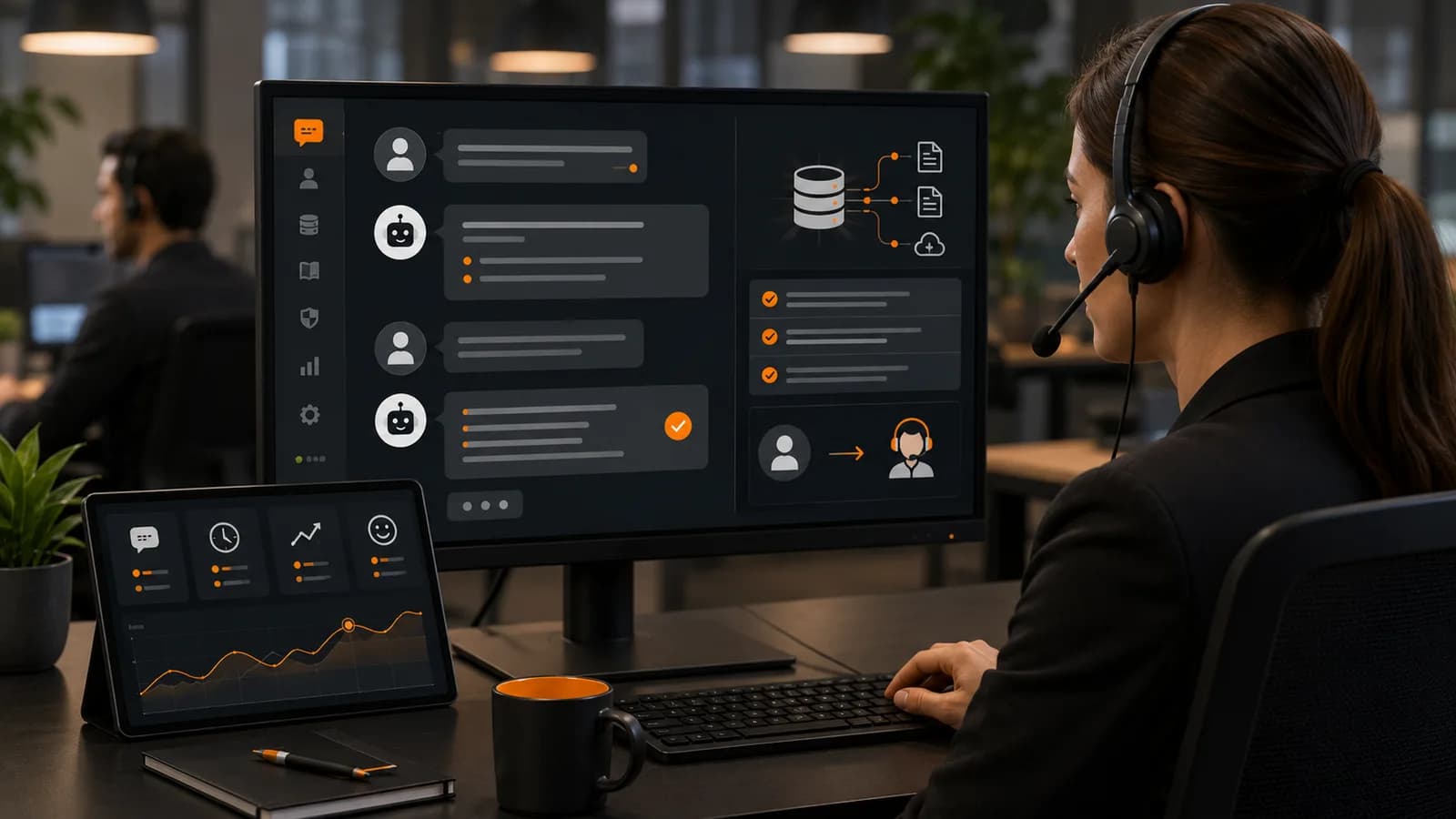
An AI chatbot for customer service can answer questions, retrieve business information and guide users around the clock, but it only works well if it understands the context, recognises its limits and hands the conversation over to a person when necessary. In 2026, the difference between a useful bot and a frustrating one is not whether it “speaks like a human”, but whether it provides correct answers, retains the conversation history and enables users to complete real tasks.
Expectations have risen. The Zendesk CX Trends 2026 report, based on 6,182 consumers and 5,115 customer experience professionals across 22 countries, states that 74% expect support to be available around the clock and 88% demand faster responses than they did a year earlier. At the same time, 74% are frustrated by having to repeat their story to different agents.
Traditional chatbots vs chatbots powered by language models
Traditional chatbots operate through rules, buttons, keywords and decision trees. They are predictable and effective for highly constrained journeys, such as choosing a department or viewing a short list of frequently asked questions. Their main limitation appears when users write in an unexpected way or combine several needs in the same message.
A chatbot based on a language model can interpret more natural wording, maintain context and generate a tailored response. This capability relies on natural language processing, the field of computer science and artificial intelligence that studies how machines can work with human language.
Criterion Traditional chatbot Generative AI chatbot Understanding Predefined intents and expressions Natural language and varied queries Response Fixed text or closed journey Response generated according to context Updating Manually edit rules and answers Update sources, instructions and evaluations Risk Dead ends and irrelevant answers Convincing but incorrect answers Best use Simple, deterministic processes Open-ended queries and broad knowledge
The new technology does not eliminate the need to design the service. An AI chatbot for customer service needs authorised sources, permissions, traceability and clear handover criteria. Without these layers, it may sound friendly while still delivering a poor experience.
What an AI chatbot for customer service can solve effectively
A good web-based virtual assistant reduces waiting times and frees the team from repetitive queries. The most suitable use cases have information available, a verifiable outcome and an escalation path when the answer is not sufficient.
Frequently asked questions: opening hours, coverage, returns, requirements, documentation and how a service works.
Purchase guidance: identify needs and recommend a category or configuration without inventing features.
Operation status: check orders, bookings, incidents or requests after identifying the user.
Information gathering: collect data before opening a ticket or transferring the conversation.
First-line support: guide users through simple checks based on approved manuals and procedures.
Classification and routing: detect intent, urgency, language and the department responsible.
In e-commerce, the bot can explain policies and check a delivery. If it detects a duplicate payment or a sensitive complaint, it should transfer the case with the complete conversation history. The objective is to prevent the customer from having to start again.
In a B2B company, the intelligent chatbot can locate procedures and prepare an initial answer. Questions about security or contractual terms should be passed to the specialist team.
What it should not decide on its own
Exceptional refunds, discounts, contractual commitments, medical diagnoses, financial decisions or situations with legal implications should not be delegated without oversight. Nor should the chatbot answer when the source is outdated or confidence is low. In these cases, the best response is to acknowledge the limitation and offer a clear route to a person.
How to connect it to your data using RAG
A general-purpose model does not automatically know your prices, contracts, orders or procedures. RAG, short for retrieval-augmented generation, can be used so that an AI chatbot for customer service answers with business information.
When a question arrives, the system searches authorised sources for relevant passages and provides them to the model before generating the answer. The Microsoft documentation on RAG describes this architecture as information retrieval and context-grounded generation.
The customer asks a question.
The system identifies the intent and searches for related information.
It retrieves passages from manuals, policies, product sheets or knowledge bases.
The model answers using that material.
The interface can display the source or link to the corresponding document.
RAG reduces dependence on the model’s general knowledge, but it does not guarantee accuracy. It may retrieve an old policy or an insufficient passage. Versions, permissions and dates must therefore be controlled, and the system must be evaluated using real questions.
If the bot accesses personal data or performs actions, the architecture must apply authentication and authorisation. It is not enough for a user to enter an order number: the system must verify that they are entitled to see that information.
Errors that make a chatbot frustrate users
The most serious failures are usually not stylistic, but flaws in service design. An AI chatbot for customer service can worsen the experience if it becomes a barrier between the customer and the company.
Hiding the option to speak to a person: forces users into circular conversations and increases frustration.
Inventing answers: the system fills gaps instead of acknowledging that the information is unavailable.
Losing context: it asks again for information already provided or fails to transfer the history to the human agent.
Using outdated documentation: it answers with prices, timelines or policies that are no longer valid.
Requesting too much information: it collects personal data that is not needed to resolve the query.
Measuring volume alone: a large number of automated conversations does not prove that problems have been resolved.
Presenting itself as a person: creates incorrect expectations and trust issues.
From 2 August 2026, Article 50 of the European Union’s Artificial Intelligence Act requires systems that interact directly with people, such as chatbots and agents, to disclose that the person is interacting with AI. The European Commission’s guidance on transparency clarifies this obligation and its date of application.
Transparency also aligns with market expectations. Zendesk states that 95% of consumers expect explanations about decisions made by AI. Although not every support answer constitutes a relevant “decision”, providing information about limitations, sources and the possibility of human review improves trust.
How to implement it without degrading customer service
Before developing an AI chatbot for customer service, select a set of queries and measure the current service. The project should improve on a baseline, not merely demonstrate that the model can hold a conversation.
Analyse existing conversations: identify reasons for contact, volume, timings, repetition and escalations.
Define the initial scope: choose frequently asked questions and low-risk actions.
Prepare the sources: remove duplicate content and assign owners to policies and documents.
Design human escalation: specify when to transfer and what context the agent receives.
Evaluate using real questions: include spelling mistakes, ambiguous queries and out-of-scope cases.
Launch gradually: begin with a share of the traffic and review failed conversations.
Measure resolution and quality: not only savings or the number of sessions.
Measure first-contact resolution, escalation, time to resolution, satisfaction, answers without sources, human corrections, abandonment and cost per conversation.
Our guide on how to integrate ChatGPT into a website explores the technical aspects in greater depth. When the assistant must perform several steps or use business tools, it is also worth reviewing what AI agents for businesses are.
How much does an AI chatbot for customer service cost in 2026?
The cost of an AI chatbot for customer service depends on its sources, integrations, channels and level of risk. As a guide for projects in Spain, the following are reasonable price ranges:
Project type Typical scope Indicative price Tightly scoped pilot One channel, frequently asked questions and limited data €3,000–€6,000 Professional chatbot with RAG Business sources, analytics, escalation and management dashboard €5,000–€15,000 Integrated chatbot CRM, tickets, authentication, actions and multiple channels €15,000–€40,000 or more
These figures are indicative and do not normally include VAT, licences, model usage, large-scale document cleaning or ongoing operations. The budget should separate analysis, conversational design, development, integration, evaluation, security, deployment and maintenance.
API usage is not the only cost. Maintaining sources, reviewing conversations and adapting integrations are part of the product. A cheap demonstration can become expensive if the team has to correct it manually.
Frequently asked questions
Does an AI chatbot replace the customer service team?
No. It normally automates repetitive queries and better prepares the cases that reach people. The team remains necessary for exceptions, negotiation, empathy and sensitive decisions. The most effective design combines immediate self-service with an easy handover that includes the full context of the conversation.
Can it check orders or customer data?
Yes, provided that it is integrated with the appropriate systems and verifies the user’s identity and permissions. The connection must limit which data it can read or modify, record actions and protect personal information. An order number alone should not provide access to private data.
How can the chatbot be prevented from inventing information?
The risk cannot be completely eliminated, but it can be reduced through controlled sources, RAG, clear instructions, confidence thresholds and continuous evaluation. The bot should cite or link to information whenever possible and acknowledge that it does not know the answer instead of filling gaps with a plausible response.
How long does it take to become operational?
A tightly scoped pilot may be ready in four to eight weeks if the documentation is organised. A system connected to CRM, orders or multiple channels may require two to five months. The timeline increases when data is scattered, permissions are complex or there are numerous exceptional cases.
Is it mandatory to disclose that an AI is responding?
Yes. For systems covered by Article 50 of the AI Act, the transparency obligations apply from 2 August 2026. Users must know that they are interacting with AI, except where this is obvious. In addition to ensuring compliance, disclosure helps establish the correct expectations.
An AI chatbot for customer service adds value when it solves real problems, uses reliable information and makes it easy to reach a person. The priority should not be to automate the largest possible number of conversations, but to provide fast answers without losing accuracy, context or trust.
Owius is a software, app and artificial intelligence development company in Barcelona with more than 25 years of experience. If you want to analyse your queries, prepare a knowledge base or create an assistant connected to your systems, discover our artificial intelligence services for businesses.