
AI Agents for Businesses: A Practical Guide 2026
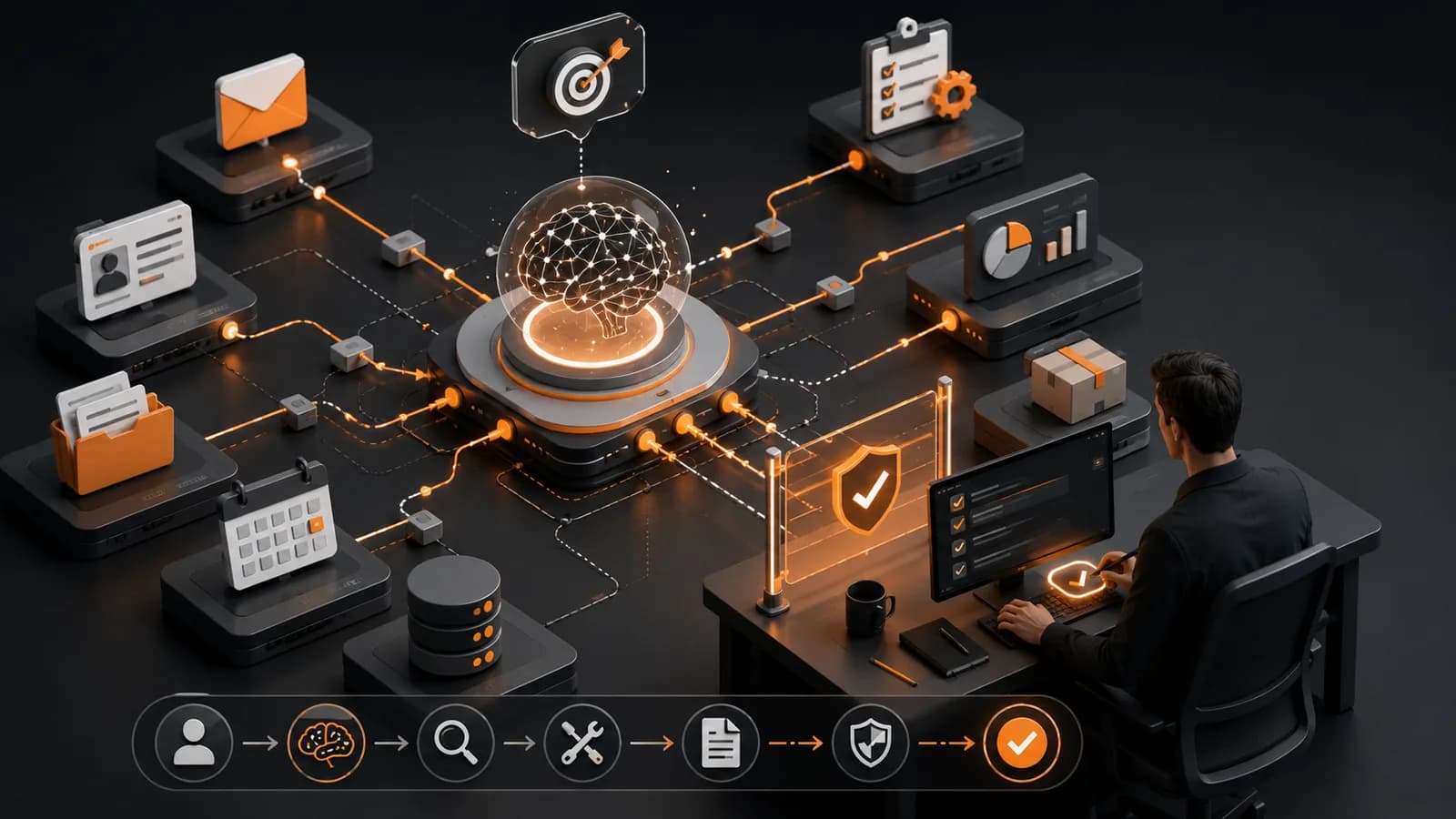
AI agents for businesses are systems capable of receiving an objective, deciding which steps to follow, using digital tools and carrying out actions with varying degrees of autonomy. Unlike a conventional chatbot, they do not merely respond: they can retrieve information, update applications, check the result and adapt their plan, always within the permissions and controls defined by the company.
In 2026, their value does not lie in indiscriminately replacing people, but in coordinating tasks that currently require switching between emails, documents, CRM, ERP and other applications. The best projects begin with clearly scoped processes, reversible actions and human approval at the highest-risk points.
What are AI agents for businesses?
An artificial intelligence agent combines a model capable of interpreting instructions with access to information and tools. Its objective is to complete a task, not simply to generate a response.
The concept comes from intelligent agents in artificial intelligence: entities that perceive an environment and act to achieve an objective. Today’s systems apply this idea to digital work, using language models to decide what information they need and which action they should take next.
For example, when given the instruction “prepare a proposal for this client”, an agent could:
Retrieve the client’s data and history from the CRM.
Find the authorised services and rates.
Review similar proposals.
Prepare a draft tailored to the case.
Check that no mandatory terms are missing.
Request approval from the person responsible.
Save the approved version in the document management system.
The agent should not invent rates or send the proposal without permission if those actions have not been authorised. Autonomy must always be constrained through the available tools, rules, permissions and supervision.
OpenAI defines agents as systems that independently perform tasks on a user’s behalf and use tools such as search, file retrieval, controlled execution and connections to applications. Anthropic makes a useful distinction: an automated workflow follows steps defined in code, whereas an agent dynamically decides how to proceed based on the results it obtains.
AI agent vs chatbot: the key difference
A chatbot responds to an input. An agent pursues an outcome and can perform multiple steps to achieve it. This difference determines both its business value and its level of risk.
Criterion Chatbot Automated workflow AI agent Objective Respond or converse Execute a fixed sequence Complete a task Decision-making about steps Very limited Defined by programming Adapted by the model Use of tools Optional Predetermined Selected according to the situation Exception handling Goes off track or responds Follows predefined rules Can reconsider the process or ask for help Predictability Medium High Lower; requires evaluation and control Example Answer frequently asked questions Send an invoice when an order is approved Investigate an incident and propose a solution
It is not advisable to use AI agents for businesses when conventional automation solves the problem. Fixed workflows are usually cheaper, faster and more predictable. An agent adds value when the path cannot be fully programmed because it depends on documents, natural language, intermediate decisions or changing circumstances.
In our projects, we often see companies request “an autonomous agent” even though their process can be handled with rules and a single model call to classify information. Reducing complexity improves reliability and makes return on investment easier to measure.
5 real business use cases
1. Customer service that investigates and acts
A traditional chatbot answers general questions. An agent can identify the customer, retrieve their order, review previous incidents, check the terms of the service and propose a solution.
For example, it could prepare a change of date or initiate a return, leaving final confirmation to a person when there is a financial impact. The relevant metrics are resolution time, the percentage of completed cases and errors—not just the number of conversations.
2. Sales management and proposal preparation
AI agents for businesses can research an opportunity, summarise meetings, update the CRM and prepare a sales draft using authorised information.
The system must distinguish between confirmed data and suggestions. It should not change discounts, contractual terms or delivery commitments without approval. In this case, return is measured through hours saved, response speed and the quality of the recorded data.
3. Invoice and document processing
A document agent can receive an invoice, extract fields, find the purchase order, identify discrepancies and request information when a reference is missing. It can then prepare the entry in the accounting system for a person to approve.
In a typical agency project, the difficulty lies not in reading the document, but in handling exceptions: suppliers with different formats, amounts that do not match or split orders. Designing these routes correctly provides more value than trying to achieve total automation.
4. Operations, procurement and logistics
An agent can monitor stock levels, pending deliveries and demand forecasts to prepare purchase proposals. It can also compare supplier alternatives and flag orders that require intervention.
Irreversible actions should remain outside its initial autonomy. It is reasonable to allow it to prepare an order, but not to send it automatically if doing so could commit thousands of euros or breach a commercial condition.
5. Technical support and IT operations
An internal agent can investigate incidents, consult documentation, review logs and perform controlled checks. If it identifies a known problem, it can propose or apply a low-risk fix; when the situation is ambiguous, it should escalate it.
In February 2026, Anthropic observed that, among the longest Claude Code sessions analysed, autonomous working time before stopping had increased from less than 25 minutes to more than 45 minutes over three months. This figure relates to a programming tool and cannot be directly extrapolated to every business process, but it shows that agents can already sustain longer tasks.
Other examples relevant to small and medium-sized businesses are included in our guide to artificial intelligence for SMEs.
How an agent works internally
AI agents for businesses are not a single technology. They are an architecture made up of several components that must be designed and tested together.
Model: interprets the objective, reasons about the steps and decides when to use a tool.
Context: includes instructions, history, documents, data and results obtained during the task.
Tools: make it possible to retrieve information from or modify systems such as CRM, ERP, email, calendars and databases.
Orchestration: controls the cycle of planning, acting, observing the result and continuing.
Memory: retains relevant information within a task or between runs, when justified.
Guardrails: validate inputs, outputs, permissions and prohibited actions.
Traceability: records the steps taken so that errors can be investigated, costs assessed and events demonstrated.
What are an agent’s tools?
A tool is a function that the model can request. It may be used to read data—for example, to check the status of an invoice—or to act, such as creating a task or updating a record.
The agent should not be given generic access to the entire application. Each tool should expose only the necessary operations, validate parameters and apply the permissions of the user or service executing it.
What role does MCP play?
MCP, short for Model Context Protocol, is an open standard for connecting AI applications to external data sources and tools. The official Model Context Protocol documentation compares it to a USB-C port: it provides a common way to connect different systems without creating an entirely separate integration for each model.
MCP can simplify access to calendars, document management systems or databases, but it does not eliminate the need for security. The company must continue to control authentication, permissions, available actions and information handling.
Limits and risks of agents in 2026
The more autonomy an agent receives, the greater the potential impact of an error. The ability to use tools turns an incorrect response into an incorrect action.
Misinterpretation: it may pursue an objective different from the one the person intended.
False information: the model may generate data that is not supported by the sources.
Prompt injection: a document or email may contain malicious instructions aimed at the agent.
Excessive permissions: a poorly configured tool may allow more information to be read or modified than necessary.
Cost and latency: each step may involve model calls, queries and additional executions.
Lack of traceability: without records, it is difficult to reconstruct why a decision was made.
Vendor dependency: models, prices and capabilities may change.
Anthropic recommends keeping people in control, protecting interactions, ensuring transparency and limiting tools and data. It also warns that no single defence completely eliminates prompt-injection attacks.
In practice, AI agents for businesses should begin with read permissions, reversible actions and mandatory approval. Sending communications, deleting information, making payments or changing contractual terms requires additional controls.
How to start an AI agent pilot
A good pilot validates a business process, not merely whether the model knows how to use a tool. The objective should be small enough to control and relevant enough for its impact to be measured.
Select a specific task: avoid vague objectives such as “automate customer service”.
Measure the current situation: record volume, time, errors, exceptions and cost.
Define what it can do: separate reading, proposing, execution and approval.
Limit the tools: provide only the access required to complete the use case.
Create test scenarios: include normal cases, incomplete data, errors and malicious inputs.
Record every step: measure accuracy, cost, duration and the need for intervention.
Expand gradually: increase autonomy only when results are stable.
For a first pilot, a single agent with a few tools is usually better than a network of specialised agents. Multi-agent systems add coordination, consumption and failure points, so they should be reserved for problems that genuinely require parallel work or very different areas of expertise.
The budget can range from a few thousand euros for a tightly scoped validation to more than €20,000 or €60,000 for an integrated solution. You can review the price ranges in our guide on how much it costs to implement AI in a business.
Frequently asked questions
What is the difference between an AI agent and ChatGPT?
ChatGPT is a conversational application, whereas an agent is an architecture designed to complete tasks through models and tools. An agent can use a model from OpenAI, Anthropic or another provider. The main difference is not the model, but access to systems, planning and the execution of actions.
Can AI agents work autonomously?
Yes, but their autonomy should be limited according to risk. They can research information, prepare documents or update statuses without constant intervention. Financial, legal, destructive or difficult-to-reverse actions should require human approval, explicit limits and records that make it possible to reconstruct each decision.
Can an SME use intelligent agents?
Yes, provided there is a repetitive process and sufficient volume to justify the investment. An SME can start with request classification, document retrieval or quote preparation. It does not need to develop a fully autonomous system: a small agent connected to a single tool may generate a greater return.
How much does it cost to develop an AI agent?
A pilot may start at between €3,000 and €8,000. An agent integrated with several applications will typically cost between €20,000 and €60,000 or more. The cost depends on the data, tools, security, evaluations, permissions and maintenance—not only on the model used.
Which processes should not be delegated to an agent?
Decisions with significant legal, financial, employment or healthcare consequences should not be delegated without supervision. Agents are also inadvisable when a fixed rule solves the task, the data is poor or nobody can review their behaviour. The complexity must be justified by a measurable benefit.
AI agents for businesses can coordinate processes and carry out real work, but they are not infallible digital employees. Their usefulness depends on defining clear objectives, limiting permissions, evaluating results and keeping people in control of important decisions.
Owius is a software, app and artificial intelligence development company in Barcelona with more than 25 years of experience. If you want to identify a use case, design a pilot or integrate agents with your systems, discover our artificial intelligence services for businesses.